Examples
Strandzha Commune
[1][2]
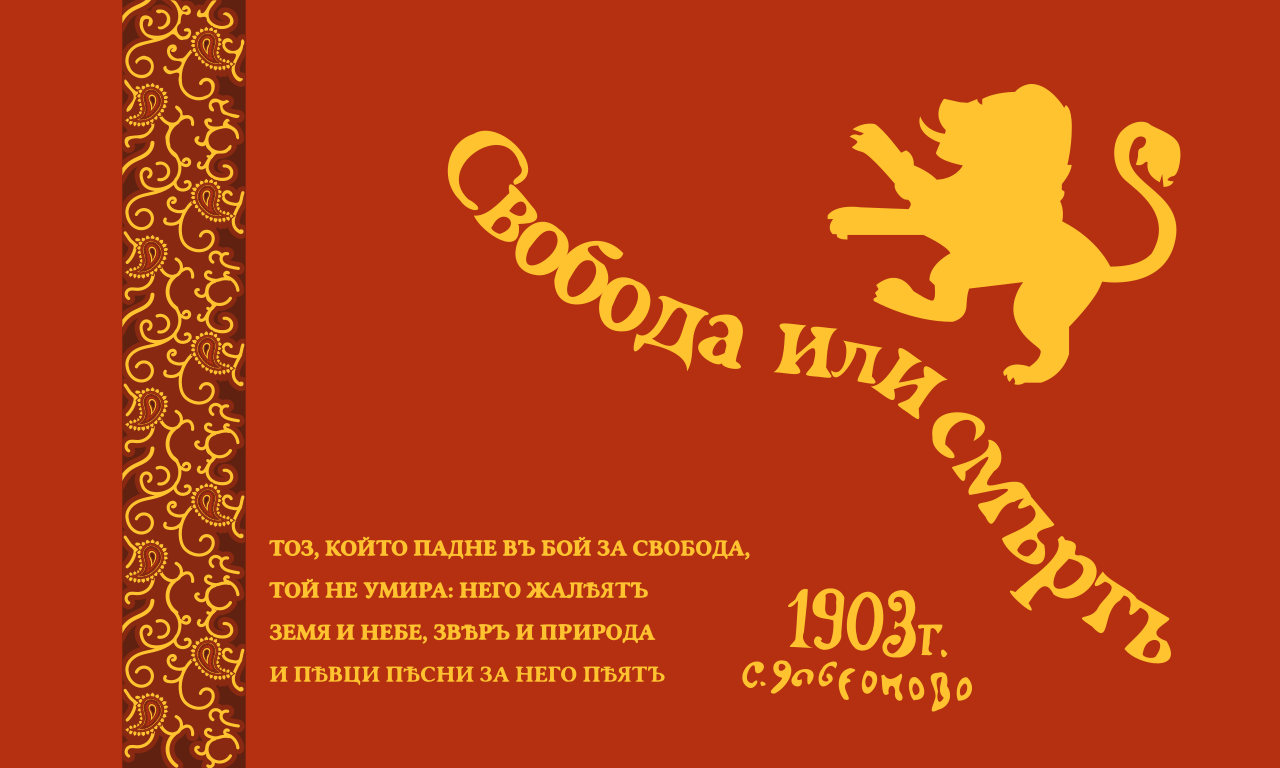 Located within modern day Bulgaria and Turkey in East Thrace at the very border of Adrianople vialyet, the Strandzha commune was a short lived anarchist communist commune between the 19th of August 1903 and 7th of September 1903. It's motto was "Freedom or Death". It's de facto leader came to Mikhail Gerdzhikov.
Between the 14th and 19th centrury, the region of East Thrace came under Ottoman rule. Increasing discontent with the rulers resulted in a period during the 19th century where Bulgarians increasingly rose up against Ottoman rule. In 1878, the Treaty of San Stefano, a conclusion of the Russo-Turkish war, established the independent Principality of Bulgaria. However, Adrianople stayed under Ottoman rule. Many Bulgarians thus fled from the region to the newly formed Bulgaria. There, they started a movement encouraging the rejoining of the region with Bulgaria through insurrection within the region, forming the International Macedonian-Adrianople Revolutionary Organisation (IMARO).
In early 1903, people began preparing for the coming uprising. Anarchist Mikhail Gerdzhikov, who was elected to lead the Adrianople revolutionary district by the underground congress of IMARO, led revolutionaries in the mountains of Strandzha to procure weapons, manifacture bombs and sabotage the Ottomans. He was forming what would become the Thracian revolutionary army. In the meantime, the villagers of Strandzha spontaneously established anarchist communism and organised into communes, bringing land, livestock and agricultural product under common ownership. The men of the villages also established minor militas. Although some rich land owners protested the new system, it came to be without significant resistance or coercion. The uprsing grew into a mass movement, with people from every background helping the insurrection. Following a series of executions, on the 17th of August a group of rebels surrounded Madzhur and began to push out and kill the soldiers that had been evicting people from the village. This prompted Gerdzhikov, on the 19th of August, to ignite the start of the uprising. By the 23rd of August, the entire region was under rebel control and all immediate tasks of the revolution were fulfilled. There had only been 40 clashes between the Ottoman soldiers and the revolutionary army, resulting in 314 dead Ottoman soliders and 38 dead rebels. Following the capture of large parts of East Thrace, with the help of other organised revolutionary forces in the area, they established the Strandzha Commune. It was founded on a communtarian system that upheld freedom, equality and solidarity. Ethnic conflicts, between the Greek and Bulgarian populations, receded through mutual argeements. Nobody attempted to build a state structure or system of authority. Villages elected commissions, each corresponding to their own militias, who were responsible for protecting the villages. These were called the Leading Combat Body and were meant as a temporar leadership. Although it was led by anarchists, anarchist propaganda was minimal within the commune. This was largely because the commune had been established spontaneously, helped by the already previously established communes of the villagers. They were quick to adopt a communist system of distribution and abolish private property, which was very apealing to the poor peasant population. Food was collected into a common warehouse and apropriate shares were portioned out. On the 7th of September, 40,000 Ottoman troups conducted a counter offensive against the commune. The revolutionary army attempted to fight back as much as possible, giving time for the civilian population to evacuate. After two months, the uprising had been completely subdued, leaving approximately 2,565 people killed, 12,880 homeless, and 20,000 refugees.
The Leading Combat Body regrouped in Sofia to assess the outcome of the uprising. The leadership emerged divided between the left, led by Gerdzhikov, and the right, led by Boris Sarafov. Gerdzhikov criticised the timing of the uprising as premature, while Sarafov wanted to go abroad to raise financial and diplomatic help. In the end, Gerdzhikov agreed to go abraod, however Sarafov behaved in increasingly hypocritical manners. The fundraising failed and Gerdzhikov returned to Bulgaria without any new funds. East Thrace would remain under Turkish rule up until modern day, despite the efforts of the IMARO. In contrast to Gerdzhikov's previous belief that it was necessary for anarchists to participate within the Bulgarian national liberation movement, at the end of the uprising he came to see it as a waste of time and devoted himself fully to anarchist activities. He would go on to found the Bulgarian Anarchist Communist Federation, which made anarchism a major force in the country. There is relatively little scholar attention on the Strandzha commune. Still, it has left a lasting legacy on the Bulgarian anarchist movement as the first attempt in the world to establish an anarchist communist society.
Makhnovshchina
[3][4]
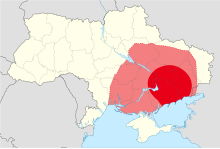 Makhnovschina was a mass anarchist communist movement in southern and eastern Ukraine between 1917 and 1921. It aimed to create a system of free soviets that would manage the transition towards a stateless and classless society. It was inspired by Nestor Makhno, commander-in-chief of the Revolutionary Insurgent Army of Ukraine. Libertarian communes were also set up durinf this period.
The territory that encompassed makhnovschina was under the control of the Russian Empire for a long time. The land was largely used for agriculture, leading to a rise in landed nobility. As the price of land rose, the poor peasant population became increasingly hostile to the nobility and wealthy middle class. With the support of the local governments, peasants organised their own agricultural cooperatives and began trading grain. The agricultural industry developed further, bringing the peasantry and proletariat together for the first time. The region also became quite ethnically diverse. Huliaipole saw strike actions and the establishment of an anarchist communist peasant group, Union of Poor Peasants.
The movement started to gain popularity during the February Revolution, in the wake of which Ukrainian nationalism and the idea of an independent Ukraine started to spread. It's official establishement is considered to have been when Huliaipole was captured by Nestor Makhno's forces on the 27th of November 1918, with the city becoming the territory's de facto capital. With Mahkno at its lead, a peasant union was established that seized control of the town from the local provisional government. The peasant population started to refuse paying rent to landowners and, with their widespread influence in the local government and lack of law enforcement, seized their land and assets, redistributing them evenly. Communes were also set up in the local villages. By January 1918, southern Ukraine had come largely under the control of the Soviet Republic. After the fall of Kiev, the Ukrainian council signed a peace treaty with the Central Powers, inviting them to oust the Soviets. Tensions between the anarchists and nationalist increased in Huliaipole, with the nationalists threattening anarchists with reprisals. A campaign of revolutionary terror was launched against them by the anarchists, leading to them planning a coup. The new Soviet regime began turning back to land nobility, kicking off the Ukrainian War of Independence. The November Revolution brought an end to WW1 in Ukraine and the Insurgents Army took back definitive control of Huliaipole, reestablishing the local worker's council and the town's trade unions. With the end of the imperial occupation and the fall of the new Ukrainian state, the focus of Makhnovschina shifted from military to political. Makhnovists convened a Regional Congress of Peasants, Workers, and Insurgents to rule, who declared their intention to make a classless society and encouraged peasants to start rebuilding society. A new system of education was established, along with agricultural cooperatives and the redistribution of land. Schools, hospitals, and children's communes were also established, drastically increasing the quality of life. Adult education programs were also instituted, along with new freedoms such as freedom of speech and press. Anarchist newspapers began circulating, publicizing anarchist ideas and furthering the Makhnovist movement. Around this time, the Red Army started to invade Ukraine, bringing with them a repressive rule. An attack by the Bolsheviks on Makhnovschina forced many insurgents to flee, beginning a period of guerilla warfare in the region. The region would be suppressed succesively by the Red Terror then the White Terror, before the Makhnovists took back control in November of 1919. This brought about a second period of reconstruction, before the territory was taken over by the Red Army in January of 1920. After the White Army started to gain ground again, the Bolsheviks and anarchists joined forces again. Once anarchists were free to operate again, they pushed the Bolshevik out and took back control of Makhnovschina. By November, the workers councils were being reconstituted, schools were established and theater was being played everyday. However, in late November the Bolsheviks pushed through again. A period of Red Terror began again. Makhnovschina was disestablished in 1921, after Mahkno and his men fled the repression of the Red Army by fleeing to Romania.
The war was won by the Red Army, leaving Ukraine as the Ukrainian Soviet Socialist Republic. Makhno would die in Paris of tuberculosis, after his health had been struggling for a few years. The anarchist movement, much like its Russian counterpart, was crushed steadily crushed by the Soviet repression. Makhnovist militant groups continued to operate, although clandestinely, throughout the 1920s, with some continuing to fight as partisans in WW2. Following the revolution of 1989, the movement experienced a resurrgence. Various anarchist groups draw on the movement for inspiration. There has been revived interest towards it in recent years, due to the Russian invasion in 2022. Within anarchist communist circles, this is one of the more famous examples of anarcho-communists actually taking control and implementing policies. Its often used as a case study and people look up to the movement and what it achieved, lamenting how it ended and how close it was to winning. The movement is still held in high regards by Ukrainian anarchist communists.[5]
Spanish revolution of 1939
[6][7][8]
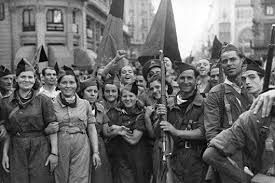 The Spanish Revolution was a social revolution which broke out at the beginning of the Spanish Civil War in 1936. It took place among various locations throughout Spain. Much of the Spanish economy was put under worker's control. The revolution was spear headed by anarchists, especially anarcho-syndicalists, who were the main force behind the movement. It collapse on the 1st of April 1939.
In the early 1930s, unrest was widespread within Spain. The 1936 election brought to power a leftist popular front government. However, the fascist and extreme right forces were deeply unhappy with this. The social revolution broke out following the attempted coup and army mutiny to overthrow the Second Spanish Republic. Worker's movements were also armed and militias were formed to fight the nationalist front. This clash also marked the start of the Spanish Civil War. The coup was forced down by the working force. By then, the CNT, an anarcho-syndicalist trade union, had around 1,577,000 members and the UGT, a major Spanish trade union, 1,447,000 members.
The CNT and UGT called for a general strike from the 19th to 23rd of July, leading to many assaulting weapon depots of the government, whether they were in uprising against the government or not. In the first few weeks, two groups were established within the revolutionaries. The radicals, which understoon the revolution as a traditional revolution, and the possibilists, the moderate sector. Local and regional administrative groups were also formed. The fronts of the Spanish Civil War were also established. During this time, Spanish worker's organisations took over power at local levels, reorganising economic facilities. The region also saw widespread implementation of socialist and anarchist communist organizational principles, primarily in Catalonia, Andalusia and Aragon. Most of the Spanish economy was soon brought under worker's control by unions, agricultural areas were collectivized, organised mostly by the CNT and UGT, and anarchist communist systems began to be implemented across municipalities, along with communes. In places were money was replaced with vouchers, costs for regular items decreased drastically. The productivity of the communes also increased by 20% compared to before. Many of the communes lasted until the very end of the war. There was also a spirit of cultural and moral revolution, with many schools being founded, literacy classes, talks on health, public access libraries, and theatrical perfomances increasing in rate. However, these effects were less drastic than the economic ones. Public order varied substantially. By August, tensions arose between the anarchists and the Communist party of Spain. Between October and November of 1936, the unions started to cede control to the state. The war dragged on and the government earned its first victory. Tension also began between the popular front and the Communist Party of Spain, which represented the country's largest foreign aid contributor, the USSR. The groups that were against the popular front soon saw their financial aid cut off and their ability to act was reduced. Thus, the republicans began reverting the changes and soon, republican held areas were mostly back to their pre-war state, with the exception of Aragon, where anarchist communism held firmly. On the 26th of September, the most radical and anarchist sectors of Catalonia began to collaborate with the state. Between November and January, the government seemed to control anarchist militias, dissolving them to join them into the Spanish Republican Army. On the 27th of February 1937, the government banned a newspaper, beginning a period of heavy censorship. In May, confrontation between supporters and opposers of the revolution intensified. In June, the government outlawed rural communes and a new government was formed, without the anarchists or revolutionaries. In August, criticism of the USSR was prohibited. During 1938, collectivization was progressively annulled despite support for it, as rich land owners came back and demanded their land back. In the end, after 3 years of brutal deaths, the Nationalists held victory in the civil war and the free state dream was crushed definitely.
The social revolution resulted in the suppression of revolutionary parties and the end of revolutionary management principles, as well as the dissolution of the republic. The spanish revolution is considered to have come the closest in history to realising a stateless society on a vast scale. It is looked up to by many in the anarchist communist community as a case study and example of a well carried out revolution. The revolution is often referenced in anarchist communist works. Additionally, many important figures, such as Emma Goldman, participated directly in its management. It remains an inspiration to many, especially because the communes worked especially well. Many still use the efficacy of the system implemented during the revolution as proof that a large scale anarchist system is possible and would be beneficial.
Paris Commune of 1871
[9][10]
 Located in Paris, it was formed during a revolt organised by the working class soldiers in the wake of the Franco-Prussian war. It lasted a total of 2 months, between the 18th of March and 28th of May 1871. It's leaders were Louis C. Delescluze an Jaroslaw Dabrowski. Although the commune wasn't explicitly anarchist communist, we can see a lot of similarities in its organisations.
The Franco-Prussian war of 1870-1871 was devastating for France. The French National Guard had defended Paris during the war. Radical movements began emerging within Paris, spurred on by the French government's attempts to put down unions and uprisings and the miserable life conditions. The radical movements and ideology began to grow within the soldiers. After the war 400 bronze cannons were left without an owner in Paris. The National Guard and the national-government both wanted to keep the cannons under their control. So, the National Guard put the cannons in parks to keep them out of the hands of the regular army and refused any compromise.
On the 18th of March, a conflict broke out between the two sides. The national-government attempted to seize the cannons but failed to do so. The confrontation resulted in the national-government retreating from the city, leaving it in the control of national-government. The revolutionaries established their own governments. Elections were held on the 26th of March, electing a Commune council. Many from upper-class neighbourhoods abstained from voting in protest, while the turnout of working class neighbourhoods was quite high. The first meeting was held on the 28th of March, adopting a dozen proposals such as the abolition of the death penalty and conscription. The new government had no president, mayor or commander in chief. Nine comissions were established to handle affairs, which reported to an executive comission. Despite internal differences, public services began to be organised. The consensus on certain policies leaned towards progressiveness, secularism and social democracy. Child labour, rent for the duration of the siege, and fines by employers were also prohibited. Women played an important role in the commune, though they could not vote. They built barriers, patched up wounded soldiers and even participated in battles occasionally, with a women's battalion being eventually established. A feminist movement was also established, demanding gender and wage equality, as well as the abolition of prostitution. Controversially, the Bank of France and the banking system remained. Francois Jourde, who had been elected as the head of the Commission of Finance, resisted the calls for appropriating the bank funds, arguing that the currency would collapse if they pulled out all the funds. Pro-Versailles newspapers were banned and pro-Commune press flourished. Popular republican paper Le Rappel, who was both critical of the commune and anti-Versailles, was allowed to remain and publish. The commune also had hostile relationship with the church, as they considered them complicit in the crimes of monarchy. The Vendôme column, honouring the victories of Napoleon I, was toppled. The commune eventually went to war with the national-government. Division arose within, whether to give priority to military operations or social change. The radicals were more in favour of the military operations, while others feared that a more authoritarian direction would destroy the social republic they wanted to achieve. A Comittee of Public Safety was created, although receiving great opposition, to hunt down and imprison enemies of the commune. Bloody Week began on the 21st of May, with the army entering Paris. On the 22nd of May, barricades were set up and the first street battles broke out. On the 23rd of May, the battle for Montmarte took place and Tuileries Palace was set on fire. On the 24th of May, the Hotel de Ville, the headquarters of the commune, were set on fire in retaliation, the National Guard fell apart, and Communards, archbishops and hostages were executed. On the 25th of May, Delescluze was shot. The day after, the Place de Bastille was captured and more were executed. Finally, between the 27-28th of May, the final battles and executions were carried out, ending in the victory of the national army and government. In the end, 877 French army soldiers were killed, with 183 missing, and at least 6,667 communards were killed, with 10 to 20,000 unconfirmed and 43,000 taken as prisoner.
Individuals involved in the resistance and defeat of the commune, mainly Adolphe Thiers, Patrice MacMahon, and Georges Clemenceau, would all come to serve important governmental positions or be elected as President or Prime Minister. The leaders of the commune who survived were captured and imprisoned, such as Louis Auguste Blanqui and Louise Michel, or went into exile such as Felix Pyat and Adrien Lejeune. Pyat had a notable comeback, since he came back from exile and was elected to the National Assembly. The Paris Commune would come to inspire many other uprisings called communes, such as Hungary in 1919 and Petrograd in 1917. It was regarded in awe and admiration later by communists and leftists. The communards also inspired many anarchists such as Errico Malatesta and Andrea Costa, to take up arms and spread their ideas faster. The commune is remembered still today and commemorated each year. For those in support, it marks hope being violently repressed by conservatism, while those agaisnt remember it was an era of chaos and class vengeance.