Key works
The Conquest of Bread
Piotr Kropotkin, 1892
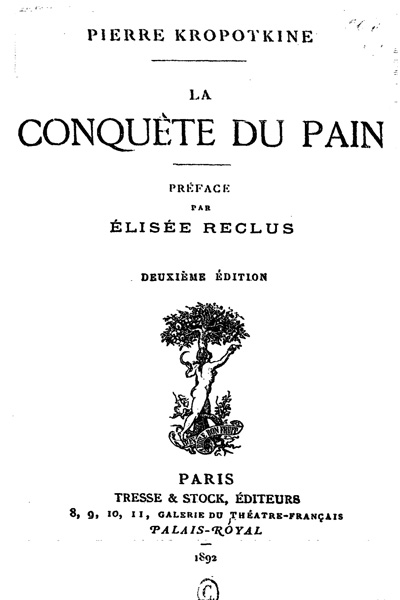 This book was originally written in French for the newspaper Le Révolté. The book is an argument for different aspects of the anarcho-communist. The first three chapters of the book argue for the common ownership of all intellectual and useful property since they were created with collective work. He postulates that every individual product is the work of everyone since we all rely and help eachother. This lays down the foundation for the right to well-being. He also considers the state's protection of private property the main obstacle from claiming this right. Next, he lays out a plan for what an anarchist communist society would look like. He uses the huge amounts of goods and services produced by modern society to argue for the feasability of an anarchist communist society. He also uses this high output to argue that people should not work more than 5 hours a day. He also argues that not only would this society be able to produce luxury products, but that they are necessary for a good quality of life. Finally, he concludes by laying out what he believes the main arguments against his thesis, the idea that people would be too lazy to work without a financial incentive for only 5 hours, and his own arguments against that, that individuals are willing to work for their passion and having their needs maintained. Finally, he warned against centralization and authoritarianism.
[1][2]
This book was originally written in French for the newspaper Le Révolté. The book is an argument for different aspects of the anarcho-communist. The first three chapters of the book argue for the common ownership of all intellectual and useful property since they were created with collective work. He postulates that every individual product is the work of everyone since we all rely and help eachother. This lays down the foundation for the right to well-being. He also considers the state's protection of private property the main obstacle from claiming this right. Next, he lays out a plan for what an anarchist communist society would look like. He uses the huge amounts of goods and services produced by modern society to argue for the feasability of an anarchist communist society. He also uses this high output to argue that people should not work more than 5 hours a day. He also argues that not only would this society be able to produce luxury products, but that they are necessary for a good quality of life. Finally, he concludes by laying out what he believes the main arguments against his thesis, the idea that people would be too lazy to work without a financial incentive for only 5 hours, and his own arguments against that, that individuals are willing to work for their passion and having their needs maintained. Finally, he warned against centralization and authoritarianism.
[1][2]
The Conquest of Bread, colloquially known as The Bread Book, is considered one of the founding works of anarchist communism. It lays down a lot of the foundational ideas of the ideology such as the right to well-being and the sketches of an anarchist communist society. Often, it is considered prophetic due to the accurate anticipation of many of the issues and struggles that would play out in the centrilization of the industry. It played a prominent role in the anarchist circles of the Spanish civil war inspired many others as well. The fall of the Soviet Union and the financial crisis of 2007-2008 also renewed interest in the book. In the modern community, it is often the source of many memes and colloquial terms such as, "breadpilled" which describes the conversion of one to becoming an anarchistcommunist.
Fields, Factories, and Workshops
Piotr Kropotkin, 1899
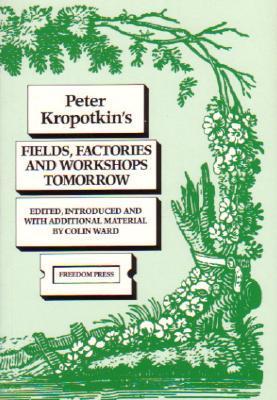 This book focuses on correlating the socialist and anarchist ideals with science. It is a compiled from essays Kropotkin had published earlier. It was published during Kropotkin's exile in London. The first chapter focuses on discussing and arguing for the decentralisation of industries. In this chapter, he discusses the idea of division of labour and argues against by examining specialisation and the way work in general is treated in current society. This chapter also includes loads of specific statistics. The next two chapters focus on the possibilities that agriculture can offer and the role of smaller industries, such as village industries, in both capitalist societies and a possible anarchist communist society. Much like the previous chapter, this is more an analysis of the contemporary state of argiculture and the economy, with lots of specific examples. He uses these chapters to cement and argument against the capitalist model of economy. He builds a case for the claim that capitalism is exploitational. Finally, Kropotkin discusses the roles and differences of brain work and manual work. This chapter is mostly theory related, rather than practical arguments and examples. It also touches on the need for a more comprehensive and well rounded education for children, while still allowing them to pursue their own interests, thus offering a critique of the modern educational system. We can clearly see throughout the book how Kropotkin tries to bring together a scientific approach and idea with the sociological and ideological view that anarchist communism and socialism brings.
[3][4]
This book focuses on correlating the socialist and anarchist ideals with science. It is a compiled from essays Kropotkin had published earlier. It was published during Kropotkin's exile in London. The first chapter focuses on discussing and arguing for the decentralisation of industries. In this chapter, he discusses the idea of division of labour and argues against by examining specialisation and the way work in general is treated in current society. This chapter also includes loads of specific statistics. The next two chapters focus on the possibilities that agriculture can offer and the role of smaller industries, such as village industries, in both capitalist societies and a possible anarchist communist society. Much like the previous chapter, this is more an analysis of the contemporary state of argiculture and the economy, with lots of specific examples. He uses these chapters to cement and argument against the capitalist model of economy. He builds a case for the claim that capitalism is exploitational. Finally, Kropotkin discusses the roles and differences of brain work and manual work. This chapter is mostly theory related, rather than practical arguments and examples. It also touches on the need for a more comprehensive and well rounded education for children, while still allowing them to pursue their own interests, thus offering a critique of the modern educational system. We can clearly see throughout the book how Kropotkin tries to bring together a scientific approach and idea with the sociological and ideological view that anarchist communism and socialism brings.
[3][4]
Fields, Factories and Workshops, is another highly influential and foundational work. At the time, it was incredibly relevant as most of the socialist and communist movements focused on targetting peasants and other agriculture related jobs with their propaganda. The working class, who was still adapting and discussing the changes brought on by the industrial revolution would have found this work a good and useful discussion point. In the modern day, the work is considered slighty outdated, but also relevant and foundational to anarchist ideal. With the decrease of jobs related to agriculture, it lost its relevance. Additionally, a lot of statistics and examples brought up are out of date nowadays. However, the theory postulated within, especially in the chapter about brain work and manual work, is still considered very relevant and holds true for a lot of anarchists, especially on the topics of class division and fufilling the needs of a population.
Mutual aid: A Factor of Evolution
Piotr Kropotkin, 1902
 Mutual aid: A Factor of Evolution is a collection of anthropological essays by Kropotkin. Published while he was living in England, it is an argument against social Darwinism, but also challenges Rousseau's idea that universal love is what motivates cooperation between individuals. Instead, mutual aid presents a scientific basis for ideas such as mutual aid. The book examines both animals and humanity in regards of cooperation. Kropotkin argues that such cooperation, especially when there is no direct and immediate exchange through it, has pragmatic and survival related advantages and that these are promoted by natural selection. This directly challenged the popular darwinian view at the time that competition pushed evolution and permitted survival rather than cooperation. In the first chapter, he uses zoological case studies and examples to support this hypothesis. Then he examines indigenous, early European, medieval societies, and the labor movement. Additionally, he draws from his own observances in Siberia and Northeast Asia. He critiques the state for destroying mutual aid by damaging historical institutions of mutual aid, particularly through private property. However, the book still mostly focuses on the biological and evolutionary aspect of mutual aid and cooperation.
[5][6]
Mutual aid: A Factor of Evolution is a collection of anthropological essays by Kropotkin. Published while he was living in England, it is an argument against social Darwinism, but also challenges Rousseau's idea that universal love is what motivates cooperation between individuals. Instead, mutual aid presents a scientific basis for ideas such as mutual aid. The book examines both animals and humanity in regards of cooperation. Kropotkin argues that such cooperation, especially when there is no direct and immediate exchange through it, has pragmatic and survival related advantages and that these are promoted by natural selection. This directly challenged the popular darwinian view at the time that competition pushed evolution and permitted survival rather than cooperation. In the first chapter, he uses zoological case studies and examples to support this hypothesis. Then he examines indigenous, early European, medieval societies, and the labor movement. Additionally, he draws from his own observances in Siberia and Northeast Asia. He critiques the state for destroying mutual aid by damaging historical institutions of mutual aid, particularly through private property. However, the book still mostly focuses on the biological and evolutionary aspect of mutual aid and cooperation.
[5][6]
Mutual aid: A Factor of Evolution is a highly regarded work, both by anarchist communists and biologists. It is praised by the scientific community as a work that has profoundly influenced human biology and one of the first systematic studies of animal communities. The basic theory of the book still holds true and, despite the constant new facts in science, they only seem to prove his theory and thus remains consistent with contemporary understanding. I feel it is important for me to stress that this is not considered as an anarchist dabbling in biology but an actual scientific work. The same can be said for the veneration from anarchist communist. Much like The Conquest of Bread, it is considered a fundemental text that you should read. It offered an alternative to historical materialism of marxists and defined mutual aid through a scientific lense. Scientific, and thus concrete, evidence for ideologies is vital for their survival and development.
[7]
Anarchism and Other Essays
Emma Goldman, 1902
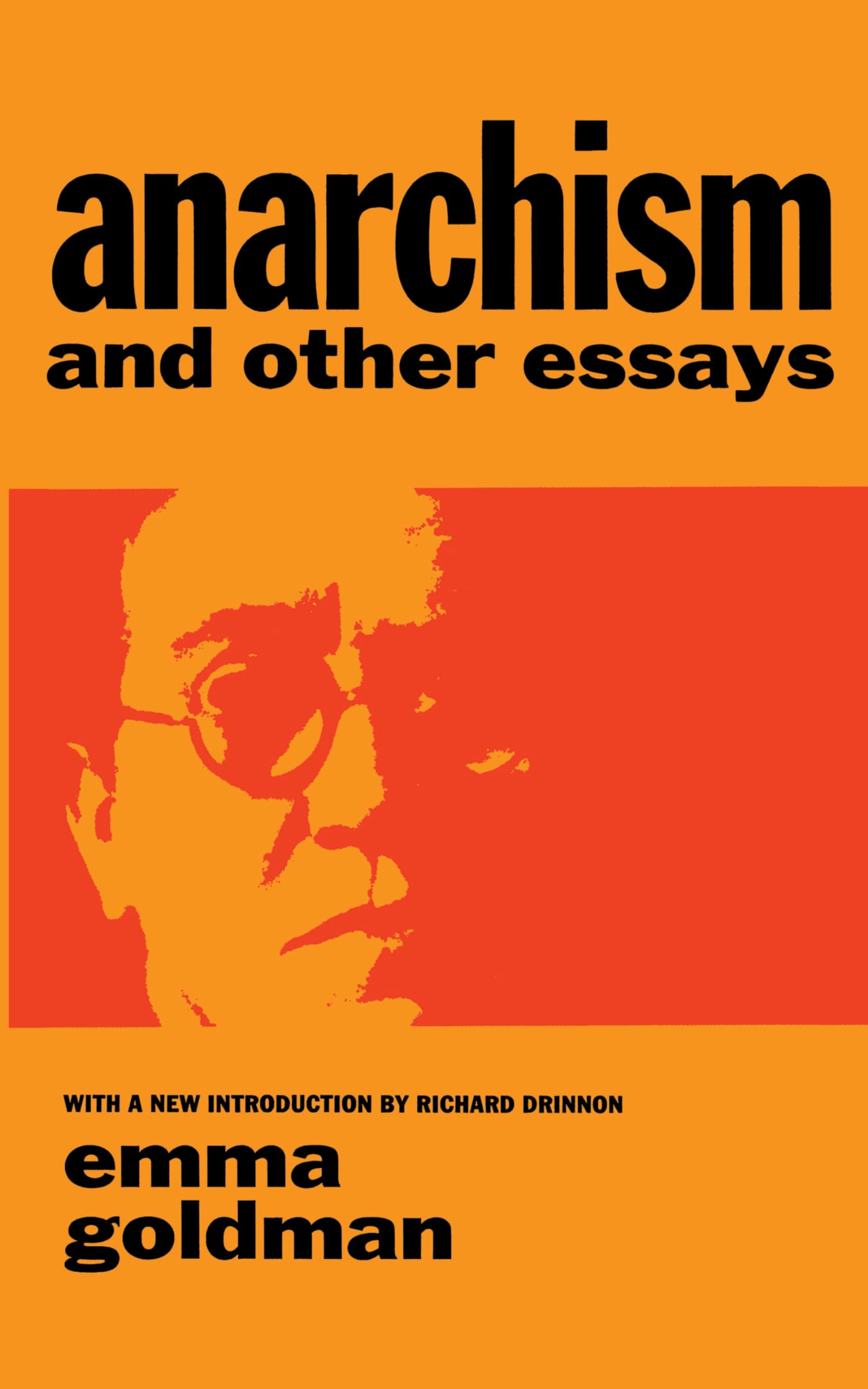 Anarchism and Other Essays is a collection of essays adapted from lectures by Emma Goldman. Because of this adaptation, the essays do read more like speeches and are very fiery and invigorating in nature. It was first published by Mother Earth Publishing associations and was Goldman's first published book. The essays touch on a number of subjects. The first essay, Anarchism: What It Really Stands For covers basics of the anarchist theory. The second essay, Minorities vs Majorities, touches on the relationship between minorities and majorities, both in terms of class but also qualifiers such as sex and other social classes. It is followed by The Psychology of Political Violence, on the effects of political violence, and Prisons: A Social Crime and Failure, which condemns the prison system. Then, Fransico Ferre and The Modern School, an essay which criticises misogyny, religion, and education and advocates for the seperation of church and state. The next four essays, The Hypocrisy of Puritanism, The Traffic in Women, Women Suffrage, and The Tragedy of Woman's Emancipation are all critiques of society's and religion's treatment of women. Marriage and Love once again touches on the unequal place of women in society but also touches on sexuality, adovacting for free love. Finally, The Drama: A powerful Disseminator of Radical Thought critices nationalism and explores how governments keep their populations distracted from their wrong doings.
[8][9]
Anarchism and Other Essays is a collection of essays adapted from lectures by Emma Goldman. Because of this adaptation, the essays do read more like speeches and are very fiery and invigorating in nature. It was first published by Mother Earth Publishing associations and was Goldman's first published book. The essays touch on a number of subjects. The first essay, Anarchism: What It Really Stands For covers basics of the anarchist theory. The second essay, Minorities vs Majorities, touches on the relationship between minorities and majorities, both in terms of class but also qualifiers such as sex and other social classes. It is followed by The Psychology of Political Violence, on the effects of political violence, and Prisons: A Social Crime and Failure, which condemns the prison system. Then, Fransico Ferre and The Modern School, an essay which criticises misogyny, religion, and education and advocates for the seperation of church and state. The next four essays, The Hypocrisy of Puritanism, The Traffic in Women, Women Suffrage, and The Tragedy of Woman's Emancipation are all critiques of society's and religion's treatment of women. Marriage and Love once again touches on the unequal place of women in society but also touches on sexuality, adovacting for free love. Finally, The Drama: A powerful Disseminator of Radical Thought critices nationalism and explores how governments keep their populations distracted from their wrong doings.
[8][9]
Goldman was a notably talented orator and gave accurate and powerful lectures that influenced many, so it is not surprising that the written form of them s held in high regards. At its release, the collection gathered favourable reviews and was recommended to those interested in social issues. Its most common criticism leveled against the essays, but also Goldman herself, was her refusal to condemn political violence as a tool for social change. The essays and Emma Goldman's work in general are highly esteemed within anarcho-communism. They are considered foundational texts and a good outlook on intersectionalism. They touch on many topics and are considered still highly relevant today. The Traffic in Women especially has gotten a lot of positive attention from other feminist scholars. Goldman's work and thoughts, along with her very life, are important especially on outlooks on feminism and sexuality.
Now and After: The ABC of Communist Anarchism
Alexander Berkman, 1929
 Now and After: The ABC of Communist Anarchism has been reprinted many times with slightly different versions, occasionally under different titles such as What is Communist Anarchism? or The ABC of Anarchism. The book title describes the contents quite accurately. The chapters are short and written in plain, easy to understand language. This is important as the book is meant to be an introduction for the non-initiated, and thus avoids the usual complicated political language in favour of being more straightforward. It is a practical guide. Although from a biased perspective, Berkman walks you through how he thinks anarchist communism could be instituted, its positives and its differences from other forms of anarchism. The chapters tackle specific questions that are often asked of anarchist communism, such as Will Communist Anarchism Work? and Whose Is The Power?, or key concepts within the ideology, such as The Wage System and Unemployment. While the chapters explain anarchist communist beliefs, they also explain the current state of the world and why exactly anarchist communism would be a better system than the current one. Quite a few chapters also go over the ideologies relation to socialism and the bolsheviks in the USSR. The book also contains many quotes of Kropotkin and discusses a lot of his ideas.
[10][11]
Now and After: The ABC of Communist Anarchism has been reprinted many times with slightly different versions, occasionally under different titles such as What is Communist Anarchism? or The ABC of Anarchism. The book title describes the contents quite accurately. The chapters are short and written in plain, easy to understand language. This is important as the book is meant to be an introduction for the non-initiated, and thus avoids the usual complicated political language in favour of being more straightforward. It is a practical guide. Although from a biased perspective, Berkman walks you through how he thinks anarchist communism could be instituted, its positives and its differences from other forms of anarchism. The chapters tackle specific questions that are often asked of anarchist communism, such as Will Communist Anarchism Work? and Whose Is The Power?, or key concepts within the ideology, such as The Wage System and Unemployment. While the chapters explain anarchist communist beliefs, they also explain the current state of the world and why exactly anarchist communism would be a better system than the current one. Quite a few chapters also go over the ideologies relation to socialism and the bolsheviks in the USSR. The book also contains many quotes of Kropotkin and discusses a lot of his ideas.
[10][11]
Due to its nature as a guide and good presentation to anarchist communism, it has remained a staple of anarcho-communist literature. While its not often recommended within the circles of the ideology, its still praised both as an introduction to the ideology for new anarcho-communists and a tool for non-anarchist communist individuals to understand the ideology better. For these reasons, it is considered a classic. While the language of writing is slightly old fashioned and the text is quite simple, focusing mainly on class with minimal intersection to sex or race, the overall content is still relevant and accurate to the ideology.
[10][12]